


Share & more
A month after twin earthquakes rocked Venezuela, most foreign rescue teams have departed and international media attention has faded, yet survivors continue to grapple with spiralling needs and intractable challenges amid a deeply politicised aid response.
According to official data, at least 5,546 people were killed and over 16,700 injured by the 24 June quakes, which hit urban and coastal areas in northern Venezuela hardest. However, the death count is expected to rise as tens of thousands remain unaccounted for.
With nearly 24,000 survivors living in state-run displacement camps and thousands more left homeless, dozens of local and international organisations are struggling to respond to mounting needs and navigate the challenges of working in a country battered by a long-standing humanitarian crisis.
Before the disaster struck, the poverty rate in Venezuela was already at 78.6%, moderate to severe food insecurity affected 40% of the population, access to basic services was limited, and the healthcare system was severely weakened. These pre-existing vulnerabilities were exacerbated by the 24 June earthquakes and, in turn, made responding to them more difficult.
“There is no sustained cold chain to distribute hot meals or proteins, water scarcity is chronic, and organisations fight a constant battle to install showers, laundry facilities, and portable toilets in spaces ill-equipped to host thousands of displaced people,” Janeth Márquez, national director of Cáritas Venezuela, told The New Humanitarian.
An initial deployment focused on large-scale emergency relief – delivering food kits, water, purification tablets, and hygiene supplies – has given way to a more complex second phase aimed at restoring livelihoods and improving housing infrastructure, she added.
Tom Fletcher, the UN’s relief chief, has announced an additional appeal of $296 million to reach 1.3 million people in the affected areas over the next six months, alongside an addendum to the UN’s pre-quake Humanitarian Response Plan that increases the targeted population from 5.5 million to 6.2 million people. As of early July, the updated plan still faced a $627 million funding gap.
Calls have grown for an end to US sanctions and the unfreezing of Venezuelan assets to help the recovery.
Since attacking Venezuela and seizing Nicolás Maduro in January – leaving allies of the former president in power under a tight leash – US President Donald Trump’s administration has lifted certain sanctions on Venezuela related to humanitarian aid. It has also provided $386 million in post-quake assistance, but this is only a fraction of the estimated $13 billion in Venezuelan oil revenues it has collected this year.
While effectively controlling the country, the Trump administration has provided no concrete information as to where this oil money has gone or the extent to which Venezuela’s languishing economy might benefit from it.
The following briefing explores the humanitarian situation in Venezuela a month after the 24 June disaster.
What is the situation for the displaced?
Acting President Delcy Rodríguez's government has focused its response on the management of 107 temporary camps sheltering more than 23,000 people across the four worst-hit states: La Guaira, Caracas, Miranda, and Aragua.
In one of these displacement camps in Tanaguarena, a coastal urban area in La Guaira state, 36-year-old Ana shares a tent with her older brother, two cousins, and nine-year-old nephew.
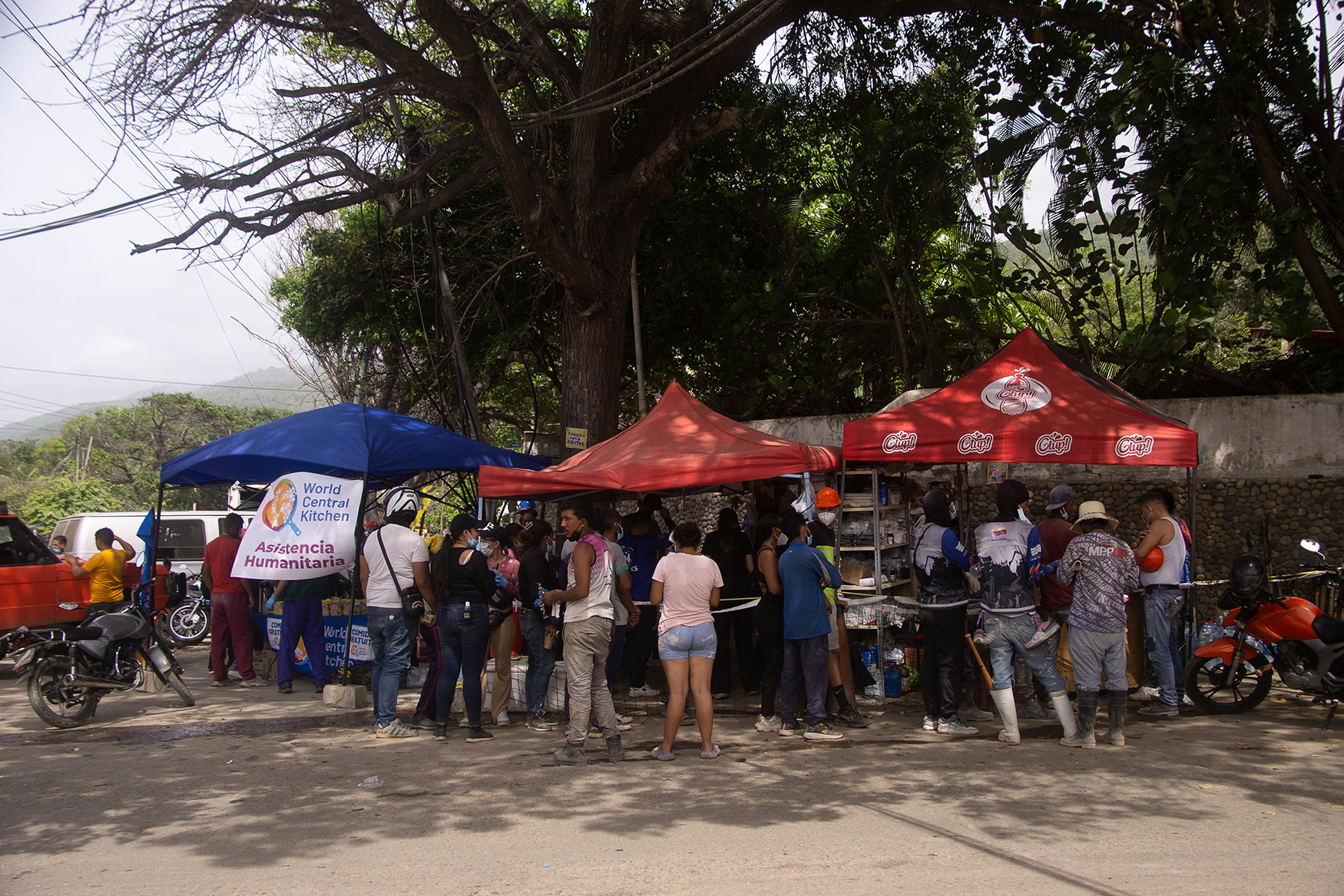
Members of the Venezuelan armed forces guard the site, where several aid organisations – including the UN’s migration agency (IOM), World Central Kitchen (WCK), and the International Federation of Red Cross and Red Crescent Societies (IFRC) – provide assistance.
Ana, like all affected people interviewed in this article, refused to be identified by her full name out of fear of government reprisals. She told The New Humanitarian she receives three meals a day.
Hygiene is one of Ana’s primary concerns. “We have a handwashing station, but there’s a lot of people here and few toilets, almost no showers,” she said. “Many people have diarrhoea.”
WCK says it has served more than one million meals to responders and Venezuelans impacted by the earthquakes. It also supports community kitchens. The World Food Programme (WFP) has also been distributing food and has launched an appeal to support half a million people during the first three months after the quakes.
The situation is even worse for many of those displaced by the disaster who are not staying in official camps and face even more acute needs.
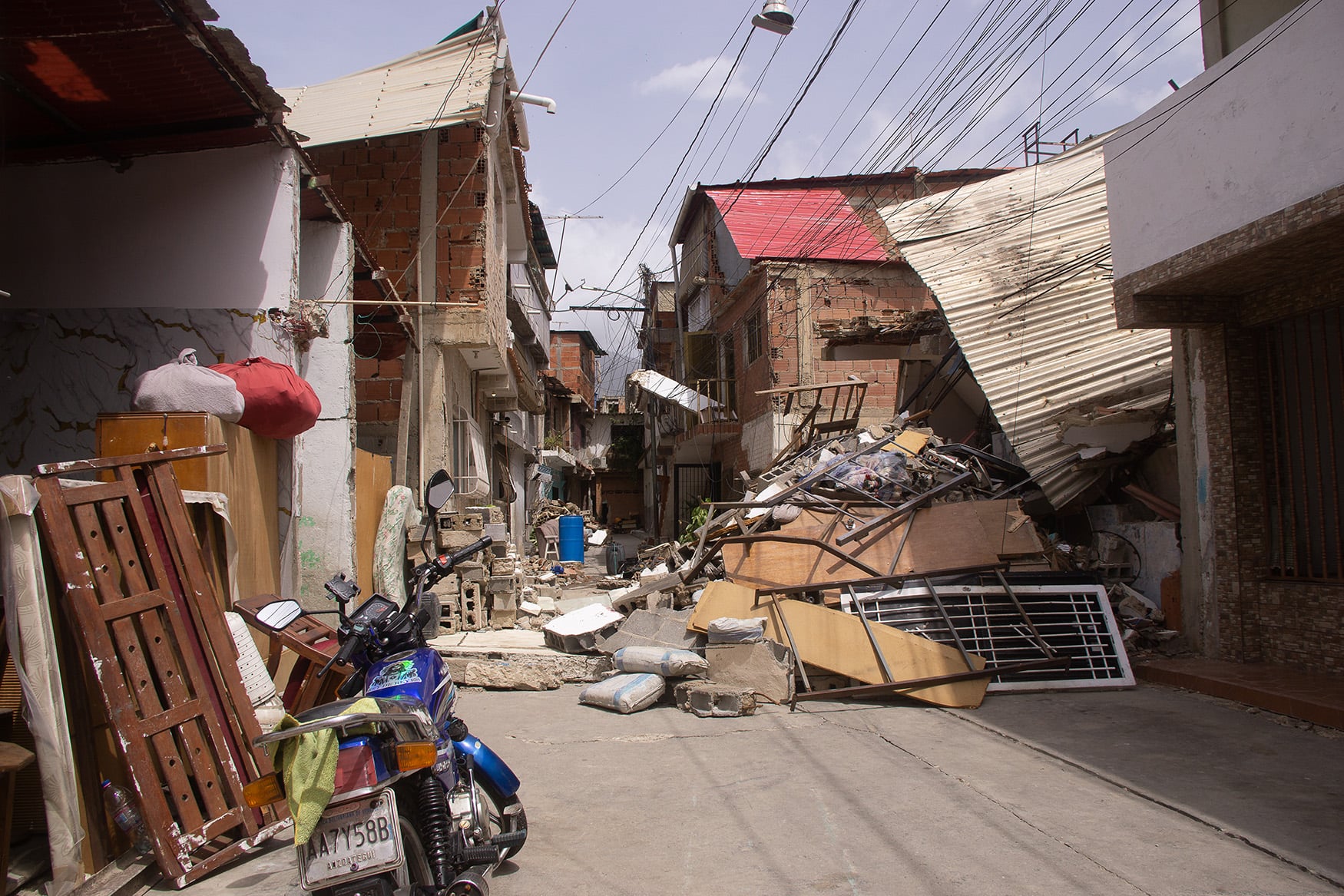
Across La Guaira, Caracas, and other cities, thousands continue to sleep rough outside damaged apartment buildings while they wait for engineers to determine if their homes are structurally safe. Others camp near the rubble that buried their loved ones.
In La Lucha, a community in the port city of Catia La Mar, residents told The New Humanitarian they had been given Chinese-donated tents by the government but lacked basic hygiene products and clean water. What food they had came primarily from NGOs, citizens, or local churches, they added.
Many have also chosen not to stay in state-run shelters because they distrust the authorities.
Three displaced people in La Guaira said they feared a repeat of what happened after the 1999 Vargas tragedy, when a series of floods and mudslides killed about 30,000 people across the state, then known as Vargas. They said they were forced to live under military surveillance in overcrowded shelters and had heard of cases of sexual assault while the armed forces were widely deployed to restore order, a period during which the military was later accused of human rights violations. Some of those state-run shelters are the same ones being used today.
“We have children with disabilities, and we refuse to confine them under those [post-Vargas tragedy] conditions. We don't trust government shelters,” said Rosario, one of several displaced women sleeping outside a drug store in Catia La Mar.
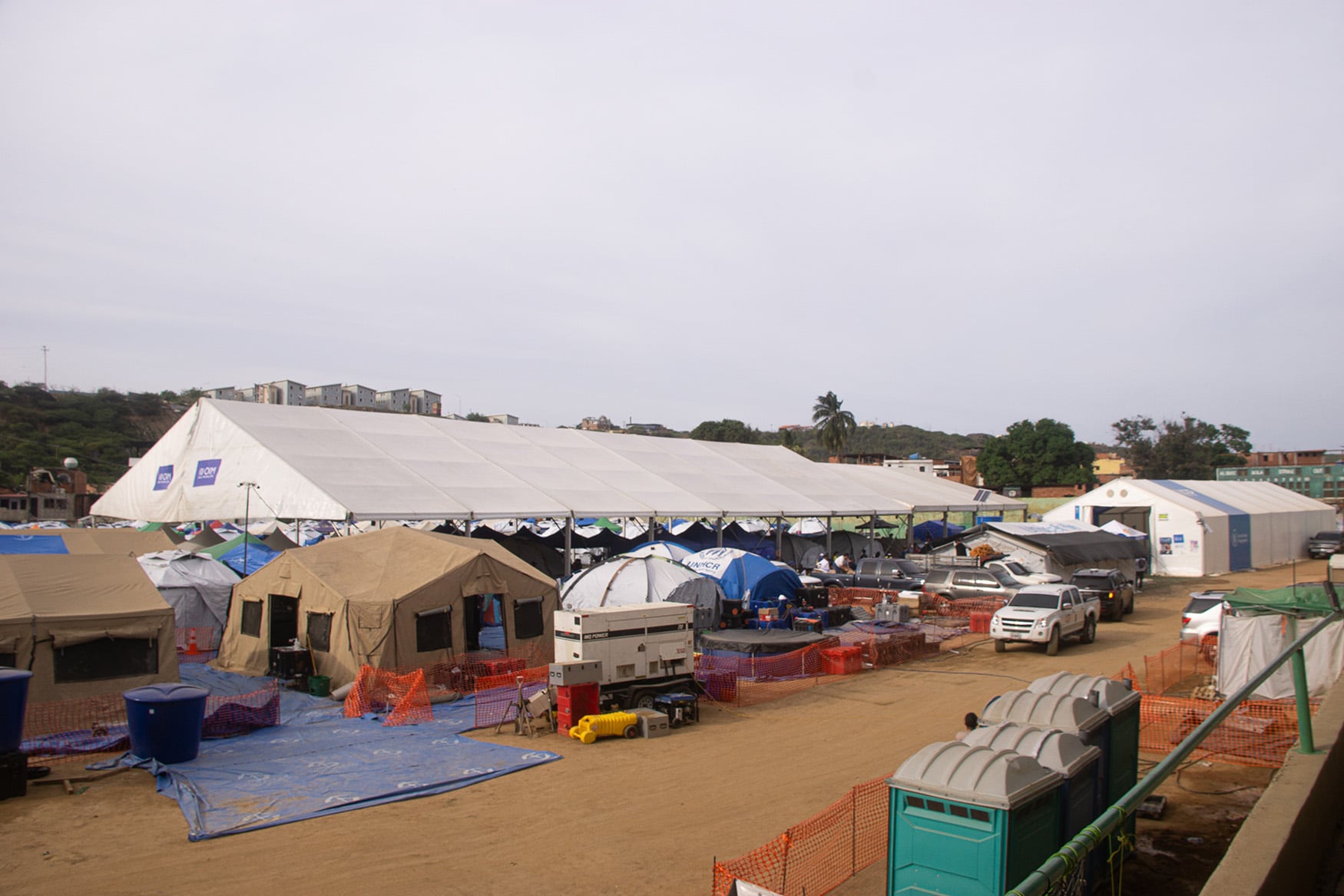
Dozens of informal camps have sprung up in different locations across La Guaira, including one outside a state-run shelter at the César Nieves baseball stadium in Catia La Mar. Ramírez, a 59-year-old teacher who asked for her first name to be withheld because it might be recognisable, is living there with her husband and two daughters. They lost their son in the quakes.
She said they preferred to remain in this informal camp with their neighbours for safety and to avoid the kinds of conflicts with strangers that occurred after the Vargas tragedy. Tankers arrive every other day to provide drinking water. Members of the community have given them tents, and Samaritan's Purse, a US-based aid group, has provided tarpaulins, but conditions remain precarious. “Almost no humanitarian aid reaches us out here," Ramírez said.
The settlement has nevertheless received some assistance. The UN recently installed showers, and women and children are allowed to use one of the bathrooms in the stadium. “[The UN agencies] also give us food, but only once around 1pm and again around 5pm,” she added.
People in many other informal settlements told The New Humanitarian they couldn't predict when they would get food, water, or access to bathrooms and healthcare.
“We are terrified at how much time we might end up spending here,” said Rosario.
As the rainy season began in early July, the government distributed emergency tents in some formal displacement sites and informal settlements, but homeless families elsewhere have had to rely on small camping tents donated by private citizens or local NGOs. These are typically inadequate for prolonged displacement.
Which other needs are surging?
In addition to the lack of housing and patchy access to basic services, aid workers are registering growing healthcare, mental health support, and protection needs. The government said 38 hospitals have been damaged by the earthquakes. Those that are still functioning are now overwhelmed.
An early July assessment by the International Rescue Committee found that only 1,038 healthcare workers were serving 1.77 million people affected by the earthquakes in Caracas, Miranda, and La Guaira. As hospitals focus on treating survivors, the organisation’s mobile health teams have registered a surge in people seeking non-emergency health services for chronic diseases and prenatal care. Mental health needs are also rising, according to Médecins Sans Frontières (MSF).
Disease prevention is another concern. In displacement sites, overcrowding, intermittent access to clean water, and inadequate sanitation create ideal conditions for the spread of waterborne diseases. Earthquake survivors in camps and settlements have already reported suffering gastrointestinal illnesses and skin conditions.
Meanwhile, concrete dust hanging over many rescue sites has been causing respiratory problems, eye irritation, allergic rhinitis, and dehydration.
The Pan American Health Organization (PAHO) continues to support the Venezuelan Ministry of Health by coordinating an emergency response network of 110 organisations co-led with the IRC.
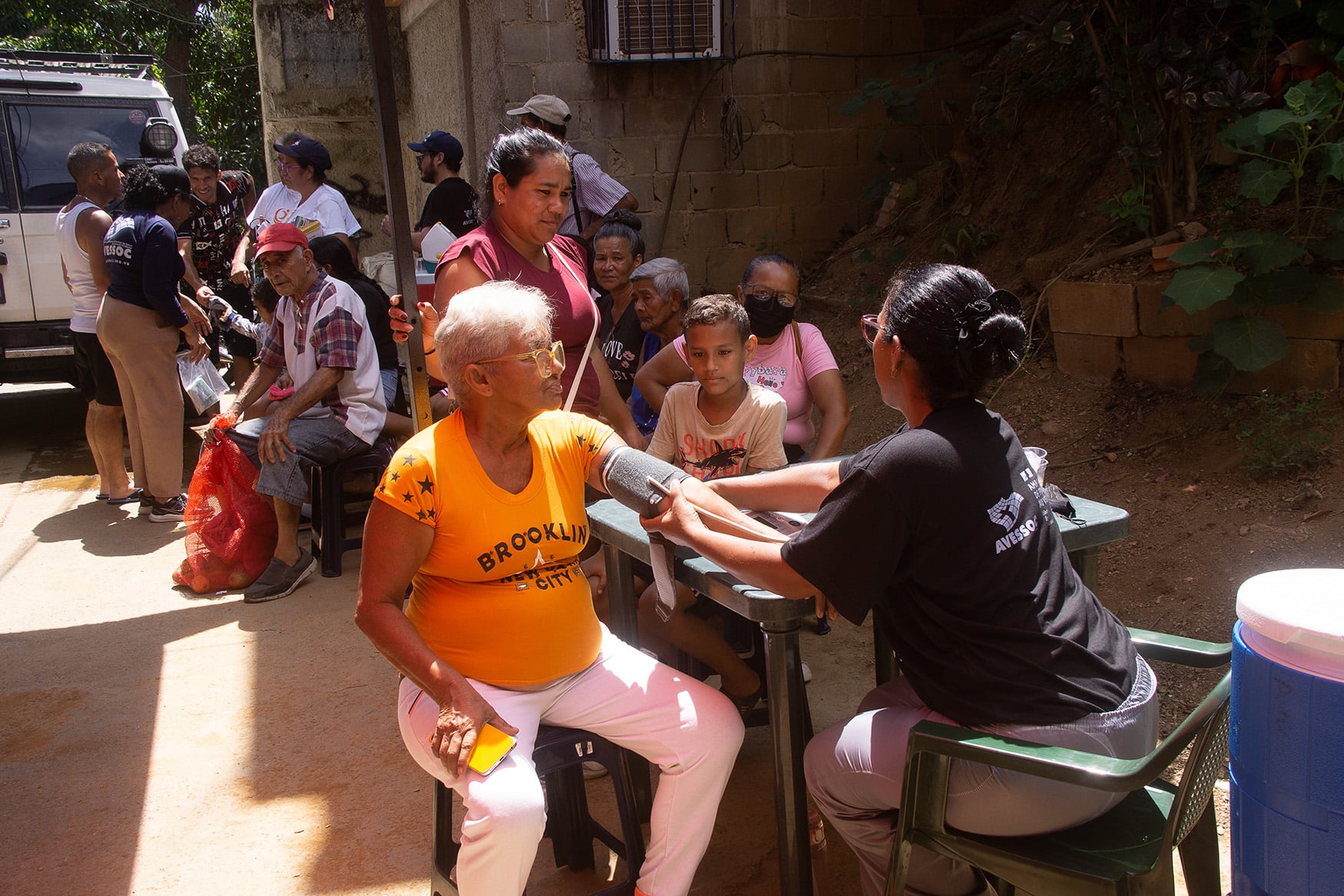
There is a visible humanitarian presence on the streets of La Guaira. MSF and the IFRC have established field tents. In Maiquetía, a coastal commercial centre in La Guaira, the Italian Red Cross has deployed a health clinic staffed by traumatology specialists and psychological support teams. Samaritan’s Purse has set up tarpaulin-covered distribution points, while direct medical assistance is being provided on-site by Team Rubicon. Similarly, the US organisation Global Empowerment Mission has distributed relief boxes, and several other aid groups, including OLI Colombia, have been providing drinking water, food, and support for children in affected areas.
Olivier de Belleroche, WCK’s response director in Venezuela, told The New Humanitarian that the food relief organisation is providing assistance at rescue sites, where family and community members continue searching for and recovering bodies.
“It is an inhumane situation, and we provide direct support to them — not only with food, but also through our ice service and access to cold water,” he said.
No survivors have been found since 2 July, but recovering the dead is not only about giving loved ones a dignified burial. Without an official death certificate, relatives cannot settle inheritances, access financial assistance, or complete the legal procedures needed to begin rebuilding their lives.
Obtaining new identity documents to replace those lost in the rubble is also vital for securing access to essential support and services.
“They need it to enter their bank accounts, or further ahead [to] have access to education and health services,” explained Diana Díaz, external relations officer at the UN’s refugee agency (UNHCR).
UNHCR has been working with partners to ensure survivors can access psychosocial support while also distributing emergency supplies such as solar-powered torches and mosquito nets, she added.
What challenges are aid groups facing?
In addition to the difficulty of securing enough resources to sustain assistance through the longer-term recovery phase amid funding cuts, aid organisations face several more immediate practical challenges.
Márquez from Cáritas said the invisibility of a survivor population scattered across wide and diverse areas complicates aid delivery, leaving those outside the official system with less assistance. Assessing the situation in more remote areas is another challenge that slows the arrival of aid to those in need. To bridge that gap, Cáritas has started operating through chapels and parish networks.
The pre-existing fragility of the health system also adds complexity. Although local hospitals and outpatient clinics have received a significant influx of medications through national and international donations, Márquez stressed that the supplies Cáritas has received are only enough to sustain services for another month.
“Once this emergency inventory begins to run low, the Venezuelan health system will once again expose the structural crisis in which it was already submerged before the tragedy,” she said. “Local organisations are forced to be creative to continue responding to medical realities with increasingly limited resources.”
Scarcity is affecting rescue operations and debris removal as well.
Ney Rodríguez, operations coordinator for the Venezuelan NGO Guy-May Rescue Group, said body recovery operations are using up biosafety supplies faster than they can be replenished. He worries that civil rescue groups, which rely on volunteers and member donations, will not be able to sustain operations without public funding.
Working in a country where aid has long been politicised and authorities have been accused of opacity and corruption in the delivery of humanitarian assistance adds further layers of complexity.
A member of an aid group in La Guaira, who asked to speak off the record, said the temporary camp where they are working was militarised and that government representatives had made it a condition that they operate under state control.
Another international humanitarian organisation declined to speak with The New Humanitarian to avoid “complicating” the operations of their partners on the ground.
Transparencia Venezuela, a non-partisan civil society organisation that tries to prevent and reduce corruption, has openly expressed fears that the government may not distribute aid properly. Hoping to prevent that, the NGO has launched an online platform tracking the humanitarian aid entering the country.
“We try to make people afraid of stealing money from humanitarian aid,” Mercedes de Freites, the organisation's executive director, said in a TV interview earlier this month.
How has aid been politicised in Venezuela?
The entangling of politics and aid is not new in Venezuela.
For years, the Chavista regime tried to restrict and control access to aid in Venezuela, and humanitarian and rights organisations have warned that limited access to reliable data impedes proper emergency responses. The government hasn’t shared statistics on nutrition since 2007 and the National Institute of Statistics suspended the publication of socio-economic indicators in 2015.
The opposition has also used aid for political purposes. In February 2019, a month after declaring himself interim president and gaining recognition from dozens of countries, then opposition leader Juan Guaidó defied Maduro, saying he would send humanitarian aid across the Colombian-Venezuelan border with or without his authorisation. The move sought to weaken Maduro by forcing the military to choose between blocking aid for citizens and disobeying their leader.
Chavismo prevailed, and the stand-off pushed Maduro to tighten his grip on incoming aid while equating outside assistance entering his country to a foreign military intervention.
In 2018, Human Rights Watch confidentially interviewed more than a dozen staff from international and Venezuelan organisations attempting to provide humanitarian aid. All of them detailed steep barriers to establishing operations in the country. They faced delays in approvals or customs clearance for deliveries, orders from hospital or government authorities to halt active assistance programmes, and limits on the supplies donated to public hospitals.
Meanwhile, the international aid community has failed to find effective ways to help Venezuelans. In 2021, talks began over the possibility of creating a UN-managed trust fund to use part of the $3 billion in Venezuelan assets frozen by sanctions overseas to finance health, education, food security, and electricity programmes. In late 2023, the UN eventually greenlighted the humanitarian fund. But by the time Maduro was proclaimed the winner of the widely contested July 2024 presidential election, nothing had materialised.
After the elections, Maduro ramped up his crackdown on dissent, persecuting not only opponents but also aid organisations providing vital medications and food.
How might the disaster impact Venezuelan politics?
The 24 June earthquake disaster has underscored the cumulative consequences of failing institutions, limited emergency preparedness, rampant corruption, and weak humanitarian coordination – a combination with its own political implications.
“The earthquakes exposed the weakness of the government,” Maryhen Jímenez, a political scientist and assistant professor at Maynooth University, said during an International Crisis Group event on 23 July. “The administrative capacity of the state to tend to the population and provide access to services has been lost,” she said, adding: “There has been a resounding rejection of the government.”
The government’s slow response to the quakes prompted a wave of indignation among many affected Venezuelans who were already distrustful of the Rodríguez administration. There have also been claims that the authorities restricted access for some equipment and volunteers to rescue sites during the critical window for finding survivors.
Rodríguez has dismissed such criticisms, saying reports of post-quake chaos are false and politically motivated.
Several displaced people told The New Humanitarian that the distribution of lifesaving resources follows decade-long patterns of mismanagement and selective humanitarian access. They said security forces have been filtering incoming aid from citizens, at times preventing them from bringing prepared meals to informal settlements.
Alba, a displaced woman who has taken on the role of a community leader since the earthquakes, said a group of residents has organised in La Lucha to receive aid directly from organisations and distribute it themselves, in an effort to keep it out of state control.
Growing discontent over the response has become a real test for the fledgling Rodríguez administration. A post-quake AtlasIntel/Bloomberg poll of more than 2,500 people showed that 65.4% of those interviewed disapproved of the government response to the disaster, more than 63% disapproved of Rodríguez, and 45.7% considered holding an election even more urgent than before.
The New York Times reported that anger is also shifting towards the Trump administration and that a number of Republican Congressmen in Washington are now calling for regime change in Venezuela. This pressure may explain why, earlier this month, the US State Department announced the beginning of talks between the Venezuelan government and the opposition on a transition to democracy.

After US abducts Maduro, Venezuelans express anger, fear, and hopelessness
For millions of Venezuelans living through long cycles of crisis, America’s actions have plunged them into a new era of trauma and uncertainty.
What next?
Amid a landscape of devastation, public works staff, civilians, and military crews have started clearing debris, and helping with the recovery of bodies.
In some parts of La Guaira, The New Humanitarian witnessed growing tensions, as relatives began camping beside or even on top of rescue sites to prevent excavators from entering while volunteers and families still searched for their loved ones.
While the estimated timeframe to relocate and stabilise families is six to eight months, Venezuela’s pre-existing housing deficit – combined with crippled public utilities and mismanagement of the public finances – means replacing destroyed infrastructure could take years. The UN has estimated the cost of recovery at $37 billion.
The International Monetary Fund (IMF) recently unfroze $346 million in assets for reconstruction. Rodríguez has also asked the Bank of England to return 31 tonnes of gold worth some $4 billion – part of assets frozen after the fraudulent 2018 election.
On 20 July, the government delivered the first 240 homes to displaced families and pledged to provide 4,000 by December. Some houses in La Lucha carry the yellow, red, or green tags assigned by the presidential infrastructure assessment commission.
Nonetheless, uncertainty continues to grip those affected.
“These evaluations aren’t definitive,” said Yamira, a 71-year-old nurse. “We are still waiting for new inspections because we were told we won’t get new housing; instead, they will help us rebuild or repair our homes here.”
For people like Ramírez, who was displaced first by the 1999 Vargas tragedy and now again by last month’s earthquakes, it is difficult to hold out much hope for the future.
“I lost my home back then, and I was never allocated a new one – only a government credit line. Now, I have lost my home again, and this time some of my family members, who are still trapped under the rubble,” she said. “Twenty-seven years ago, I was able to pull myself up, but today I don’t think I can do it again."
Edited by Daniela Mohor.


